Showing posts with label decriminalizing homosexuality. Show all posts

Tuesday

Uganda: Stop the "Kill the Gays" Law Now. SIGN THE PETITION

Tuesday

UPDATE: 200,000 around the world have already signed this urgent call. Add your voice now to keep up the pressure! 

Can you please sign and share this petition demanding that Ugandan President Museveni stop the human rights violations by publicly vowing to veto the "Kill the Gays" bill? 

In the next 48 hours, conservative lawmakers could move a bill that would make being LGBT in Uganda a crime punishable by death. 

This hateful bill is part of a pattern of the Ugandan government's violent repression of pro-democracy forces within the country - and time is running out to stop it.

Ugandan President Museveni must vow to veto the "Kill the Gays" Bill


President Yoweri Museveni: 

The world is united with human rights activists in Uganda, in asking that you publicly declare your intention to veto the "Anti-Homosexuality" bill. 

Don't let this law, and the worsening human rights situation in the country, make Uganda in to a pariah nation in the international community.


0 comments

Thursday

Should Being Gay Be a Family Secret? Why is it hard for some parents to accept their child's true identity?

Thursday
An Italian film currently in theaters, entitled "I Am Love", features the shocking upheavals in a family, one of which involves the college-aged daughter who reveals to her mother that she has fallen in love with a woman. The daughter keeps her relationship a secret from her father, whom she believes won't understand. But her mother, although stunned at first, is lovingly accepting - and shares in her daughter's joy at having found someone to love. How common is this mother's reaction?


While much progress has been made in the last several decades with regard to accepting homosexuality as part of the human fabric, homophobia still exists within families and society at large. Sadly, too many children and young adults still don't feel comfortable revealing their sexual identity to their parents. Keeping this part of themselves a secret from their family is an emotional burden no one should have to bear. After all, if we cannot reveal ourselves to those we're closest to, what does family mean?

The reality is that there are no clear cut demarcations defining heterosexual, homosexual, bisexual. While some may not want to acknowledge the fluidity of human sexual identity, the truth is that each person's sexuality falls somewhere on a broad continuum. Even those of us who define ourselves as heterosexual may have same-sex sexual fantasies or occasional sexual feelings toward persons of our own gender. And those who define themselves as gay may occasionally have sexual feelings for the opposite sex. Sexuality stems from our fluctuating emotions, which don't necessarily fall into neat sexual categories. So how can we rigidly define what is "normal"? And how can we fail to accept our child's true nature, even if others label homosexuality as abnormal?

We teach our children to be honest with others and true to themselves. And we claim we want to accept our children for who they truly are. Shouldn't we then assure them that they can feel comfortable being open about their sexual identity?
 
This is not to deny that it may be difficult for some heterosexual parents to learn that their child is gay. As much as we may want to be role models of tolerance and openness, we can get trapped by the desire to see our children in our own image, to expect them to be like us in certain fundamental ways. But, like the mother in "I Am Love," what connects us to our children on the deepest level is our authentic love for them-which then allows them to love others deeply and authentically.

- Dr. Ana Nogales (www.psychologytoday.com)

0 comments

Gays vs. Straights: Any Differences in Sexual Satisfaction?

by Outrage Magazine on Thursday, August 19, 2010 at 1:25am

Sexually, homo- and heterosexual couples are more similar than different. 
by Michael Castleman


The phrase, "battle of the sexes," implies a yawning chasm between men and women that includes their sexual sensibilities. The corollary implication is that lesbian/gay couples have less of a "battle." Because they are members of the same gender, they are more likely to appreciate lovers' feelings, including feelings about sex.

But is that really true? Are same-sex couples sexually more compatible than heterosexual couples? It's amazing how little research has focused on this--just two studies (1983 and 1991, and they provide only a cursory look at comparative gay/straight sexual satisfaction).

Fortunately, Canadian psychologists just published a more comprehensive study (Journal of Sex Research, 2009, 46:57). They surveyed 423 people in couples, ages 18 to 58, 322 women, 101 men, 253 in mixed-sex and 170 in same-sex relationships.

This survey has strengths: Participants were recruited from the Internet and were geographically diverse, from across North America. The survey was anonymous, so answers were presumably more honest than they might have been in face-to-face interviews. And the sex questions represented only a small fraction of the total survey, which dealt with social support, so participants had no idea they were participating in a "sex survey."


But the survey also has weaknesses: Compared with the total population, participants were more white (91%) and more college educated (53%).

As a result, the findings cannot be considered definitive. Nonetheless, they are intriguing.

* Sexual desire. Desire declines in long-term couples, but on average, men retain more desire than women, so we would expect men in gay couples to feel the most desire, and women in lesbian couples the least, with the men in mixed-sex couples expressing more libido than the women. But in the survey, sexual desire was pretty much the same for all couples, with gay men and lesbians expressing slightly more desire than heterosexuals.

* Sexual communication. Similarity breeds comfort, so compared with those in heterosexual couples, we would expect people in lesbian and gay couples to feel more satisfied with their sexual communication. But in the survey, satisfaction with sexual communication was "virtually identical" for all groups.

* Sexual activities. "All groups displayed very similar sexual repertoires." The only difference was that gay men were more into anal play. (Of course, lesbians don't have penis intercourse, but they can enjoy insertive vaginal play using fingers and dildos.)

* Satisfaction with sexual activities. It was remarkably similar for all groups. The only difference was that women, both lesbian and straight, felt somewhat more satisfied with non-genital caresesses than men, both gay and straight, presumably because compared with women, men tend to be more genital-focused. But all groups expressed very similar levels of satisfaction with their lovemaking.

* Satisfaction with orgasm. All groups enjoyed the same satisfaction.

Of course, this study has limitations--modest numbers and a sample that's not truly representative. But as sex surveys go, this one was reasonably well done.

People in lesbian, gay male, and mixed-gender couples have their differences. But bottom line: Contrary to the conventional wisdom, in terms of sexual desire, communication, and satisfaction, people in homo- and heterosexual couples are much more similar than different.

From http://www.psychologytoday.com/blog/all-about-sex/200905/gays-vs-straights-any-differences-in-sexual-satisfaction

0 comments

Saturday

Understanding AIDS -- a labor of love

Saturday
Reuters
Friday, July 23, 2010; 10:30 AM

VIENNA (Reuters Life!) - At AIDS 2010, the PLWHA and the PLHIV have come together with MSMs, IDUs and other MARPs to see if they can bring about GIPA.

In other words, this week's international AIDS conference in Vienna has plunged journalists seeking to make sense of the global epidemic into a thick alphabet soup.

Once you've figured out the basics, like HIV -- human immunodeficiency virus, and AIDS -- acquired immunodeficiency syndrome -- the acronyms move to another level.

MSM is short for men who have sex with men, IDUs are injecting drug users and MARPs are most at risk populations and LGBTs are lesbians, gays, bisexuals and transgender people.

PMTCT is prevention of mother to child transmission and PEP stands for post-exposure prophylaxis and PrEP, conveniently, is pre-exposure prophylaxis.

"Letters are swimming before me like alphabet soup. It's almost like they make a new one up every day ," said one reporter laboring through the conferences' press statements.

AIDS drugs are known as ART, or antiretroviral therapy, HAART, highly active antiretroviral therapy, and there's a new generation known as NNRTIs, or non-nucleoside reverse transcriptase inhibitors.


Then you get the acronyms that include acronyms inside them.

PLHIV are people living with HIV, PLWHA stands for people living with HIV and AIDS, while GIPA means greater involvement of people living with HIV and AIDS.

"It's one of the hardest things to get your head around when you start working in this area," said one communications official at the media center at the biennial conference.

"It's a steep learning curve, but the sad fact is that after a while it becomes the norm, and then you start talking AIDS."

(Reporting by Kate Kelland; Editing by Steve Addison) REUTERS

0 comments

Wednesday

HIV epidemic may be imminent in the Philippines

Wednesday
The report, published in the Journal of the International AIDS Society, said young adults, gay and bisexual men, prostitutes, injecting drug users, overseas Filipino workers and sex partners of all these groups were vulnerable to contracting the virus.

"There is no guarantee that a large HIV epidemic will be avoided in the near future. Indeed, an expanding HIV epidemic is likely to be only a matter of time as the components for such an epidemic are already present in the Philippines," wrote Anna Farr and David Wilson at the National Center in HIV Epidemiology and Clinical Research at the University of New South Wales in Sydney.

Unlike other countries in the region, the spread of HIV in the Philippines has been described as "low and slow" because of a disperse geography, relatively uncommon intravenous drug use, sexual conservatism and high male circumcision rates.

But the authors said an HIV epidemic was possible because of the presence of many conditions "for a large, increasing and generalized epidemic."


"These include: a low rate of condom use; unsafe practices among intravenous drug users; large migration rates; increasing trends in extramarital and premarital sex; a lack of education and common misconceptions about HIV/AIDS; and cultural factors that inhibit public discussion of issues of a sexual nature," they wrote.

The report also focused on the 7.5 million Filipinos working abroad in 170 countries.

"By participating in casual unprotected sex or other risky behavior while overseas in higher prevalence settings, overseas Filipino workers become a substantial source of new HIV cases in the Philippines upon their return home," they said.

Overseas Filipino workers make up 30 to 35 percent of all HIV cases reported in the country, the report said.

The Philippines has the lowest rate of condom use in Asia - just 20 to 30 percent among groups at risk of HIV infection such as sex workers, according to the report.

"A common perception is that condoms are only for birth control and not for protection against HIV and other sexually-transmitted illnesses," the authors wrote.

"This perception is reinforced by the view that condoms are discouraged by the Roman Catholic Church. Government family planning programs have policies against supplying condoms to unmarried people."

Monthly HIV diagnoses among homosexual men jumped to 704 by 2008 from 328 in 2003, while the figure among bisexual men shot to 289 from 92 within the same period. The average age of diagnosis has also fallen significantly, from 36 before 2005 to 29 years recently, the authors wrote.

(Reporting by Tan Ee Lyn; Editing by Kazunori Takada) 
Source: http://www.reuters.com/article/idUSTRE64A1HG20100511?rpc=60

0 comments

Monday

Bodies of gays in Senegal desecrated amid rising homophobia across Africa

Monday
Last update: April 11, 2010 - 11:01 PM
THIES, Senegal - Even death cannot stop the violence against gays in this corner of the world any more.

Madieye Diallo's body had only been in the ground for a few hours when the mob descended on the weedy cemetery with shovels. They yanked out the corpse, spit on its torso, dragged it away and dumped it in front of the home of his elderly parents.

The scene of May 2, 2009 was filmed on a cell phone and the video sold at the market. It passed from phone to phone, sowing panic among gay men who say they now feel like hunted animals.

"I locked myself inside my room and didn't come out for days," says a 31-year-old gay friend of Diallo's who is ill with HIV. "I'm afraid of what will happen to me after I die. Will my parents be able to bury me?"

A wave of intense homophobia is washing across Africa, where homosexuality is already illegal in at least 37 countries.

In the last year alone, gay men have been arrested in Kenya, Malawi, Sierra Leone and Nigeria. In Uganda, lawmakers are considering a bill that would sentence homosexuals to life in prison and include capital punishment for 'repeat offenders.' And in South Africa, the only country that recognizes gay rights, gangs have carried out so-called "corrective" rapes on lesbians.

"Across many parts of Africa, we've seen a rise in homophobic violence," says London-based gay-rights activist Peter Tatchell, whose organization tracks abuse against gays and lesbians in Africa. "It's been steadily building for the last 10 years but has got markedly worse in the last year."

To the long list of abuse meted out to suspected homosexuals in Africa, Senegal has added a new form of degradation — the desecration of their bodies.

In the past two years, at least four men suspected of being gay have been exhumed by angry mobs in cemeteries in Senegal. The violence is especially shocking because Senegal, unlike other countries in the region, is considered a model of tolerance.
"It's jarring to see this happen in Senegal," says Ryan Thoreson, a fellow at the International Gay and Lesbian Human Rights Commission who has been researching the rise of homophobia here. "When something like this happens in an established democracy, it's alarming."

Even though homosexuality is illegal in Senegal, colonial documents indicate the country has long had a clandestine gay community. In many towns, they were tacitly accepted, says Cheikh Ibrahima Niang, a professor of social anthropology at Senegal's largest university. In fact, the visibility of gays in Senegal may have helped to prompt the backlash against them.

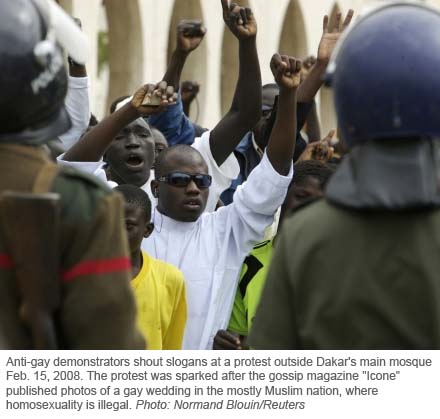
The backlash dates back to at least February 2008, when a Senegalese tabloid published photographs of a clandestine gay wedding in a suburb of Dakar, the capital. The wedding was held inside a rented banquet hall and was attended by dozens of gay men, some of whom snapped pictures that included the gay couple exchanging rings and sharing slices of cake.

The day after the tabloid published the photographs, police began rounding up men suspected of being homosexual. Some were beaten in captivity and forced to turn over the names of other gay men, according to research by the International Gay and Lesbian Human Rights Commission.

Gays immediately went into hiding and those who could fled to neighboring countries, including Gambia to the south, according to the New York-based commission. Gambia's erratic president declared that gays who had entered his country had 24 hours to leave or face decapitation. Many returned to Senegal, where they lived on the run, moving from safehouse to safehouse.

In March 2008, Senegal hosted an international summit of Muslim nations, which prompted a nationwide crackdown on behaviors deemed un-Islamic, including homosexuality.

The crackdown also coincided with spiraling food prices. Niang says political and religious leaders saw an easy way to reach constituents through the inflammatory topic of homosexuality.

"They found a way to explain the difficulties people are facing as a deviation from religious life," says Niang. "So if people are poor — it's because there are prostitutes in the street. If they don't have enough to eat, it's because there are homosexuals."

Imams began using Friday sermons to preach against homosexuality.

"During the time of the Prophet, anytime two men were found together, they were taken to the top of a mountain and thrown off," says Massamba Diop, the imam of a mosque in Pikine and the head of Jamra, an Islamic lobby linked to a political party in Senegal's parliament.

"If they didn't die when they hit the ground, then rocks would be thrown on them until they were killed," says Diop, whose mosque is so packed during Friday prayer that people bring their own carpets and line up outside on the asphalt.

Sermons like Diop's were carried on the mosque's loudspeakers as well as in Senegal's more than 30 newspapers and magazines.

Around this time, in May 2008, a middle-aged man called Serigne Mbaye fell ill and died in a suburb of Dakar.

His children tried to bury him in his village but were turned back from the cemetery because of widespread rumors that he was gay. His sons drove his body around trying to find a cemetery that would accept him. They were finally forced to bury him on the side of a road, using their own hands to dig a hole, according to media reports.

The grave was too shallow and the wind blew away the dirt. When the decomposing body was later discovered, Mbaye's children were arrested and charged with improperly burying their father.

In the town of Kaolack three months later, residents exhumed the grave of another man believed to be gay. In November 2008, residents in Pikine removed a corpse from a mosque of another suspected homosexual and left it on the side of the road.

The grave-robbing has shocked even hardened gay activists, such as Nigerian Davis Mac-Iyalla.

"People have done horrible things (in Nigeria). I have seen people spit on coffins and people spit on graves," he said. "But it stopped there."

Among the people who appeared in the photograph published from the gay wedding was a young man in his 30s from Thies. He was an activist and a leader of a gay organization called And Ligay, meaning 'Working together,' which he ran out of his parents' house.

He was HIV-positive and on medication.

When the tabloid published the photograph, Diallo went into hiding, according to a close friend who asked not to be named because he too is gay. Unable to go to the doctor, Diallo stopped taking his anti-retrovirals. By the spring of 2009, he was so ill that his family checked him into St. Jean de Dieu, a Catholic hospital in downtown Thies, says the friend.

He was in a coma when he died at 5:50 a.m. on May 2, 2009, according to the hospital's records. Although the hospital has a unit dedicated to treating HIV patients, the young man's family never disclosed his illness, according to the doctor in charge.

Several gay friends tried to see Diallo in the hospital but were told to stay away by his family, says the friend.

When the AP tried to speak to Diallo's elderly father at his shop on the main thoroughfare in Thies, his other children demanded the reporter leave. One sister covered her face and sobbed. Another said, "There are no homosexuals here."

Hours after he died, his family took Diallo's body to a nearby mosque, where custom holds the corpse should be bathed and wrapped in a white cloth. Before the family could bathe him, news reached the mosque that Diallo was gay and they were chased out, says the dead man's friend. His relatives hastily wrapped him in a sheet and headed to the cemetery, where they carried him past the home of Babacar Sene.

"A man that's known as being a homosexual can't be buried in a cemetery. His body needs to be thrown away like trash," says Sene. "His parents knew that he was gay and they did nothing about it. So when he died we wanted to make sure he was punished."

The video footage captured on a cell phone shows what happened next. His thin body was placed inside a narrow trough in the middle of the bald cemetery dotted with clumps of weeds. Then you hear shouting.

The shaky image shows a group of men jerking around the edges of the grave. One of them straddles the pit and shovels away the fine gray dirt until you can see the shrouded body. It's still inside the trough when they tie a rope around its feet.

They yank it out, cheering as the body bends over the lip of the grave. The shroud catches on the ground and tears off, revealing the dead man's torso.

Rassul Djitte, 48, watched from behind the wall of a nearby school. He had not known Diallo personally, but says he felt a stab. "People were rejoicing," he says. "They dragged him past me and his body left tracks in the sand. Like a car passing through snow."

0 comments

Saturday

Islam 'recognizes homosexuality'

Saturday
Abdul Khalik , The Jakarta Post , Jakarta | Fri, 03/28/2008 1:38 AM 

Homosexuals and homosexuality are natural and created by God, thus permissible within Islam, a discussion concluded here Thursday.

Moderate Muslim scholars said there were no reasons to reject homosexuals under Islam, and that the condemnation of homosexuals and homosexuality by mainstream ulema and many other Muslims was based on narrow-minded interpretations of Islamic teachings.

Siti Musdah Mulia of the Indonesia Conference of Religions and Peace cited the Koran's al-Hujurat (49:3) that one of the blessings for human beings was that all men and women are equal, regardless of ethnicity, wealth, social positions or even sexual orientation.

"There is no difference between lesbians and nonlesbians. In the eyes of God, people are valued based on their piety," she told the discussion organized by nongovernmental organization Arus Pelangi.

"And talking about piety is God's prerogative to judge," she added.

"The essence of the religion (Islam) is to humanize humans, respect and dignify them."

Musdah said homosexuality was from God and should be considered natural, adding it was not pushed only by passion.

Mata Air magazine managing editor Soffa Ihsan said Islam's acknowledgement of heterogeneity should also include homosexuality.

He said Muslims needed to continue to embrace ijtihad (the process of making a legal decision by independent interpretation of the Koran and the Sunnah) to avoid being stuck in the old paradigm without developing open-minded interpretations.

Another speaker at the discussion, Nurofiah of the Nahdlatul Ulama (NU), said the dominant notion of heterogeneity was a social construction, leading to the banning of homosexuality by the majority.

"Like gender bias or patriarchy, heterogeneity bias is socially constructed. It would be totally different if the ruling group was homosexuals," she said.

Other speakers said the magnificence of Islam was that it could be blended and integrated into local culture.

"In fact, Indonesia's culture has accepted homosexuality. The homosexual group in Bugis-Makassar tradition called Bissu is respected and given a high position in the kingdom.

"Also, we know that in Ponorogo (East Java) there has been acknowledgement of homosexuality," Arus Pelangi head Rido Triawan said.

Condemnation of homosexuality was voiced by two conservative Muslim groups, the Indonesian Ulema Council (MUI) and Hizbut Thahir Indonesia (HTI).

"It's a sin. We will not consider homosexuals an enemy, but we will make them aware that what they are doing is wrong," MUI deputy chairman Amir Syarifuddin said.

Rokhmat, of the hardline HTI, several times asked homosexual participants in attendance to repent and force themselves to gradually return to the right path.

0 comments

Friday

Malawi gay couple choose silence in court, decision expected May 18

Friday

Source: The Daily Times
By Theresa Chapulapula

The suspected gay couple of Tiwonge Chimbalanga and Steven Monjeza Tuesday invoked their right to remain silent in a case in which they are answering charges of buggery and gross indecency.

The two told Blantyre Chief Resident Magistrate Nyakwawa Usiwausiwa that they have chosen to remain silent and will just file their defense. The magistrate has reserved the ruling on the matter to May 18.

The two, Tiwonge Chimbalanga and Steven Monjeza, were Tuesday expected to start defending themselves after the court ruled that they have a case to answer on all counts on March 21.

The two were arrested on December 28 last year just a few days after holding a public engagement at a lodge along Chileka Road in Blantyre.

During yesterday’s court session the state through Dickens Mwambazi indicated that the state was ready for court proceedings. But a lawyer representing the suspected gay couple Noel Supedi sitting in for Mauya Msuku told the court that the couple decided to remain silent.

“The defense will not parade any witness. They have decided to remain silent,’’ Supedi stated. He however asked for two weeks to file submissions on the matter.

Another State Prosecutor Fostino Maele told the court that they needed two weeks after being served with the submissions from defense to file theirs. Usiwausiwa allowed both parties to file their submission within the stated period.

“Make sure that the submissions have been filed in the stated period. If you don’t file the court will proceed to deliver its verdict on May 18,” the magistrate concluded.

As usual a crowd of people gathered at the court to see the couple and some were peeping through the window as proceedings were underway. It took the Police Mobile Force Officers who were providing security at the court to chase the crowd. Chimbalanga popularly known as Aunt Tiwo continued amazing people as he continued displaying his effeminate flirting characteristics.

International observers also attended the court hearing that took less than 15 minutes.

0 comments

Thursday

Iranian LGBT: Persecuted, harassed, raped, tortured, threatened with death, forced into operations

Thursday


This Iranian women was flogged for being a lesbian
By Paul Canning

In a series of personal stories submitted to the International lesbian, gay, bisexual, trans and intersex association (ILGA) the Iranian Railroad for Queer Refugees reveals massive state-sponsored persection of lesbians, gay men and transgender Iranians.

Iranian transgender people

Iran carries out more sex change operations than any other nation in the world except for Thailand. Since the mid-1980s transgender individuals have been officially recognized by the government and allowed to undergo sex reassignment surgery with the government even providing up to half the cost for those needing financial assistance. A change to a birth certificate is also allowed.

However many transgender surgeries are actually performed on gay men who report being coerced. They and actual Iranian transgendered people report being persecuted, tortured and coerced to undergo sex reassignment procedure.

Many of those Iranians undergoing operations end up far worse off because of carelessly performed or even incomplete reassignment procedures and absent pre-surgery counseling.

Those individuals who receive psychotherapy are sometimes assaulted and abused by their therapists. There have been incidents where therapists tell their patients to have sex with them if they want to prove that they have feminine emotions. There have been other incidents where transsexuals have been raped by their surgeons. Surgeons are aware that their transsexual patients do not often have financial and/or family support so they commit the sexual violence without fear of any sanction. Often, victims cannot file a complaint with the police as police themselves commit the same sort of acts all the time.

Most transgendered individuals cannot get a job until they go through a sex-change operation and receive a new identification card. Despite the supposed government assistance, most transgendered people lack the financial means for a sex-change operation. Consequently, many of them turn to prostitution in order to earn money for the sex reassignment procedure. Prostitution brings with it, however, all types of risks and dangers from sexually transmitted diseases and HIV infection to abuse, rape and murder.

Despite the government's theoretical acceptance of transgender people, like gays and lesbians, they are always in danger of getting beaten and arrested by the unaccountable Basiji forces (a paramilitary volunteer militia). Transgender people have been deemed 'criminal by the Basiji and delivered to Mafased, the organization responsible for dealing with 'moral corruption', which can imprison people for days and subject them to physical and psychological torture.

Judges, who can arbitrarily decides whether to set a person free or not, usually use sexist, brutal and demoralizing words and acts.

Sayeh has been arrested three times by the Basiji and forced to sign papers guaranteeing not to appear in public anymore with his transgender attire and appearance after two days of psychological torture in a detention centre - even though he was just wearing a simple shirt and pants at the time of his arrest. He fled Iran to Turkey and was granted asylum status by the United Nations High Commissioner for Refugees (UNHCR) and eventually found sanctuary in Canada in 2007.

Unfortunately, after a year of living in Toronto, he reportedly committed suicide due to serious problems related to his sexuality. The police did not disclose much detail on the mysterious circumstances of Sayeh’s death. It is not certain whether he committed suicide or had been killed and became another victim of homophobia.

In February 2007, a 40-year-old transgendered man from the neighbourhood of "Sheikhtappeh" in the city of Orumieh, Azerbaijan, was found murdered. The transgendered man, who was known as "Giz Naser" (meaning Naser the girl) in his neighborhood, was attacked and murdered by three men.

Holiya is a 24-year-old Iranian male-to-female transgendered person. In 2006, she left Iran for Turkey because of her sexual orientation and gender identity. Holiya is from one of Iran's wealthier families but unfortunately experienced severe difficulties when her family found out about her sexuality. Her family found it hard to accept the fact their son was a transgendered woman. Holiya's family repeatedly said she brought shame onto their honour. Eventually, they stopped financially supporting her and Holiya had no choice but to leave home.

While Holiya was in Turkey seeking asylum, she worked illegally at night in order to afford basic life expenses. The IRQR often sent her money through the organization’s Refugee Financial Assistance fund. Holiya applied to UNHCR. When she was granted refugee status, the UNHCR referred her case to the American embassy.

In May 2008, after 14 months of living in such a difficult situation, she finally left Turkey and arrived in the United States. Holiya is now living in Portland, Oregon, but she is not yet secure. Holiya continues to wear men's clothes because she hasn't come out and told people she is a male to female transgendered person. She fears people’s reactions because she used to live in Iran where she had to hide everything.

Iranian lesbians

Although not as visible internationally as the situation for Iranian gay men, Iranian lesbians also face viscious persecution.


Many are forced by society and by their family to live a lie and marry a man. Under Iranian law, it is lawful for a man to rape his wife. The only unlawful rape of a woman is 'zena' or adulterous rape.

If arrested, they risk being raped, whipped, persecuted or even tortured to death. Women convicted of lesbian sex face flogging or, after conviction for a fourth time, the death penalty.

If they are raped by strangers or acquaintances, they and their family members are often reluctant to file a formal complaint because being raped is itself a matter of shame and disgrace. Even when complaints are filed, they do not prosper as the law pertaining to the crime of rape requires four male witnesses to prove the legitimacy of the accusation.

If their sexuality is discovered by their family members, they are likely to be beaten and abused if not abandoned. Abandonment often means drug abuse and prostitution.

Sometimes, lesbian women are forced by their families to consult a doctor, a process which can involve agitation and trauma. There have been cases where a lesbian required hospitalization after being prescribed a dangerous pill used typically for serious mental illnesses. They may even be persuaded to undergo a sex-change operation, which can lead to depression, various mental and physical conditions and even suicide.

A university student in her mid-twenties in Tehran told IRQR that she was barred from leaving the family home for there months when her mother discovered she was a lesbian. After which she was under constant supervision and was prevented from communicating outside the family.
A Human Rights Watch report describes the experience of a 23-year-old woman in Tehran who had two girlfriends who were subjected to forced therapy and drugging. After the parents learned of her lesbianism, she was told that she must take estrogen for her condition of hormone deficiency. One of her girlfriends was forcibly medicated from age 15 until age 21. The side effects of the drugs included an inability to concentrate, constant dizziness, chronic fatigue, and loss of sexual interest.

Maryam is a 29-year-old Iranian lesbian refugee who IRQR helped connect to the UNHRC after she fled to Turkey. Her family forced her to marry one of their relatives. The husband raped her every night. She could do nothing about it because one of the first duties of women in the Islamic Republic of Iran is “sexual delivery” to their husbands.

She went to a doctor after the repeated brutal marital rapes and was told: “you appear to have been raped by an animal and you need urgent health care now.” However, her family ordered her to be patient and stay at her husband's home. She was then repeatedly beaten by her husband but she eventually escaped and went to a friend's house.

While she was there, her brothers came when she was out and told her friend they were going to kill their sister to save the family's honour. She allegedly had dishonored the family because she had left her husband and has suspicious connections with other women. That was when she fled Iran to Turkey.

Sanaz's mother forced her to marry a man after discovering she was a lesbian. Had she refused, her parents would have disowned her. She had no means of supporting herself. She continues to live in fear of her husband discovering her sexuality and thus might become abusive or publicly 'out' her in a shameful divorce. She also described a pattern of forced sex with her husband.

Taraneh is an Iranian lesbian refugee who has lived in the Netherlands for the past 17 years. She was 21 when she was first arrested in Iran and consequently spent three months in prison where she received 100 whip lashes.

Later, she was forced into marriage by her family. Yet, she continued her relationship with her girlfriend clandestinely.

Her neighbors became aware of her same-sex relationship and reported her to the police. The police forces raided her house, beat her severely and took her to a detention centre. She was severely tortured there and was forced to confess to her lesbianism.

She spent several days in solitary confinement while bleeding and lacking access to sanitary and medical facilities. In the Revolutionary Court of Esfahan, Taraneh was offered freedom if she agreed to co-operate with the secret police to identify other lesbians. After rejecting this offer, she was beaten again and was then sent to prison.

She spent two years in prison and received 180 lashes. She was flogged in front of other prisoners. Throughout this period, she was repeatedly threatened with imminent execution. Every night, she and other prisoners were taken to the prison’s courtyard and were forced to run. They were told by the guards that “people like them must be burnt to death.” When Taraneh was finally released after several years of torture and trauma, she immediately escaped to Turkey and applied for refugee status.

Shaghayegh is another Iranian lesbian who was forced to escape from Iran along with her partner in February 2007.

In 2001, she was forced into marriage, which consequently made her depressed and suicidal. During this period, she became friends with Nazanin, who is now her partner. Shaghayegh’s husband became aware of their relationship and blackmailed them. He repeatedly threatened that he would report them to the police. His threats continued even after Shaghayegh divorced him.

The husband once attempted to murder Nazanin by throwing a stone at her while she was driving. Left without any legal recourse, Shaghayegh and Nazanin had to buy themselves short periods of safety by giving the former husband a lot of money. They spent many of their days in fear as they sometimes heard stories about a lesbian friend of theirs getting arrested, beaten up, tortured and raped by the Basiji forces.

One month before leaving the country, the couple received constant threats from a stranger who wanted to force them into group sex. The stranger harassed the couple repeatedly by knocking at their door and windows at night and calling their cell phones. Once again, Shaghayegh and Nazanin were unable to report these incidents because, in the eyes of the police, they would have been not the victims but the criminals.

On Feb. 22, 2007, Shaghayegh was alone at home when she heard a knock on her door. She opened the door to be informed that police forces had come to confiscate her satellite receiver. While in her apartment, the police agents also noticed several DVDs beside the TV set. Among the DVDs were “illegal movies,” lesbian movies, and pictures of Shaghayegh and Nazanin kissing and making love.

The police took the DVDs with them and asked Shaghayegh who the man of the house was. After telling them that he was away, Shaghayegh was told to send her husband to them by next week. Understanding that the DVDs contained enough evidence to sentence her and Nazanin to arrest, torture and rape, if not outright execution, Shaghayegh and Nazanin arranged their escape to Turkey immediately and applied for refugee status once they arrived there.


Iranian gay men

In December 2008, Ali, who is 30, escaped from Iran to Turkey. He was caught when he was having sex with a man by his father, who was a member of the Islamic Revolutionary Guard. As a result, he lost his job, and he and his family were threatened with death.

He was arrested several times in Iran, the last time was in the summer of 2007 while he was on vacation in the north of Iran, and the Islamic Guard detained him simply because he was wearing a T-shirt and jeans and had spiky hair. He doesn’t feel safe even in Turkey because the father of the man he had sex with is in the Revolutionary Guard and has the ability to find him there and have him killed so he can cover up the scandal of his queer son.

In an interview with IRQR, he said: "I didn't do anything. I'm just a gay man who was born in a country in which my existence was forbidden, just for being gay, just for having a special feeling which is not that of a majority of society. I love guys. It is my right to be free, but I have to live in exile for it. I need help.”

On May 10, 2007, eighty-seven queer men were arrested and beaten by the police at a birthday party in Esfahan.

Around 10 p.m., the police force first entered the second floor of the home where the family members were gathered and arrested some of them and a child. The family members were released the day after. The police then went to the third floor where the party guests were gathered, turned off the lights, shot ‘fake gunshots,’ forced everyone to lie on the ground, began beating them and walked over them. Then the police dragged either head-bags or their blouses over the guests’ heads, forced them to go to the street and pushed them with a baton into a military car.

While the car had a normal capacity of 15-20 people, the police stuffed all 87 men into one vehicle. The people who were witnessing the event on the street reported that the clothes of the arrested men were torn and their faces were bleeding. One of the guests jumped out of the third floor window and needed an operation on his two broken legs as a result.

Based on information received, they were transferred to the Esfahan Dastgerd jail and were exposed to severe pressure and torture. Of the 87 men arrested, 60 were released unconditionally in the weeks following their arrest while 27 were later released on bail. They are not believed to have had access to lawyers or their families.

Farhad, the 19-year-old man for whom the birthday party was held, was condemned to pay 150,000,000 Tomans (about 170,000 USD) as bail. A judge reportedly said that those detained following the private party will be charged with consumption of alcohol and homosexual conduct ('hamjensgarai') even though there was no evidence to prove that these men were gay or were engaging in same-sex relations.

It is important to note that when storming the house, the police forces were equipped with cameras and were accompanied by four clergymen, making them effectively ready to satisfy the legal requirement of four “righteous men” to prove the act of sodomy. No evidence could be collected, however, to prove the crime of “lavat” because at the time of the invasion, no one was engaging in any sexual conduct.

The situation could have been different, though. This incident is just one of the many examples that show the extent to which the walls of homes are transparent and the halls of justice are opaque in Iran. It also shows the extent to which respect for privacy and personal dignity is fragile in Iran.

IRQR acquired information about this incident in Esfahan through its queer members in Iran. After some of our members contacted us by phone to report the situation, they were contacted by intelligence agents (Setad-e Khabari-e Ettelaat) and were brought into their office. They were accused of working for foreign organizations and asked to explain why there was once an Italian man at one of their parties.

When they denied the accusation, they were told that the intelligence agency has information about all of them and were presented with albums that contained the pictures and contact information of all their gay friends. They were asked to pay significant amounts of money in order to be released. Following their release, several of the arrested men left the country for security reasons. These incidents illustrate the extent to which members of the queer community, their telephone conversations and their relationships are monitored and controlled.

In April 2007, two gay men, 26-year-old Farsad and 24-year-old Farnam, received 80 lashes for giving a small party in their house, and were told that they would receive further lashes later for having an “improper” relationship.

Farsad and Farnam moved together into an apartment in the winter of 2007 to start their life as a couple. They invited a small group of their friends to celebrate their union. Just fifteen minutes after the party began; the police broke into their house and arrested everyone.

The arrestees were beaten brutally and were then transported to a police detention center. They spent the entire New Year holidays in a prison cell. “We were beaten to the point that my spine hurt permanently; I still feel the pain caused by the fists pounding my face,” Farsad says. They were accused of advocating decadence, homosexuality and prostitution.

Because they were arrested together, the authorities insisted on more details about their relationship. During the police interrogation, they were asked, "Did you have sexual intercourse with each other?” They did not admit to this, and eventually they were sentenced for having an improper relationship, for which they received a sentence of 80 lashes.

All other guests were released conditionally and they were ordered to remain in the city and not contact each other. Two weeks before the execution of their sentence, the party attendees were arrested again and were sentenced to 60 lashes each, all received the same day. Farsad and Farnam were told that the 80 lashes were just for holding the party, and that their sentence for the improper relationship would be executed later.

At the age of 21, Farsad set up a weblog in order to meet people like himself. The police found his address through his IP information and arrested him.

He spent three weeks in solitary confinement and he was accused of obscenity, advocating decadent values and homosexuality. He was sentenced to six months in prison. After completing his sentence, he suffered from depression and post-traumatic stress with symptoms so debilitating they forced him to get hospitalized.

Then his diary was found by his stepfather, who demanded Farsad denounce his homosexuality. When Farsad resisted, his step-father took him to Qom (a holy city in Iran and a centre for ayatollahs) to be seen by the grand ayatollahs. He spent several nights in custody, and was humiliated by the security forces there. They threatened him with stoning unless he denounced his homosexuality.

Traumatized by the threats, he was taken to see a grand ayatollah. Before him, he signed his confession and forgiveness plea. He was then returned to Tehran, where he received 95 lashes before being released. Almost as an afterthought, he was questioned by the supreme leader’s office in the university where he was studying and was expelled from school as well.

A documentary called 'Out in Iran:Inside Iran's Secret Gay World' was broadcast by the Canadian Broadcasting Corporation (CBC) in February 2007. The documentary, which was filmed in Iran, provides the world’s first look at life inside Iran’s persecuted gay community. The director meets an astonishing group of courageous people with heartbreaking stories.

One of these people is Hooman, a gay man who has been the victim of abuse, torture, rape and unlawful arrests. The Basiji forces have attacked him several times and have abused him physically and sexually. He has been warned not to inform the authorities, for this would only cause him to receive more severe punishments.

Before the release of the documentary, one of the young gay men interviewed in the documentary, named Mani, was forced to escape from the country. Mani's employer at the pharmaceutical firm where he worked at found out that he was gay and that he had participated in the documentary and reported him to the police.

The police recognized that Mani was the person who had recently done interviews with the BBC and CBC and raided his home to arrest him. Mani, however, was not home then. Recognizing the dangerous nature of the situation, Mani took refuge at a friend's house temporarily and planned to leave the country immediately. His father ordered his bank account to be frozen in an attempt to prevent him from fleeing the country. Mani finally left Iran with the help of IRQR.

Since the documentary was broadcast in February 2007, IRQR have received reports from Iran about the abuse and torture of at least one of the young gay men whose face was shown in the documentary.

The young man, named Farzan, had been identified by the Basiji forces and repeatedly beaten and bullied by them. He was threatened with more severe punishments if he decided to report his case. His family members also become aware of his sexual orientation and have since put him under extraordinary pressure and restrictions. These incidents show the great political and social forces that are at work to keep Iranian queer people an invisible and oppressed population.

Hossein, 22, escaped from Iran to Canada in September 2006, where he has been languishing while awaiting official refugee status and the granting of asylum by Canadian government. He is a musician who used to perform at various celebrations, including weddings and parties. These gatherings were often raided, but usually the host would pay the authorities a bribe, and that would end the matter.

He had his first relationship at age 12 with the son of a neighbor. It lasted two years.

In September 2006, he was playing along with other musicians at a private gay party in a home. The party was raided, and the police viciously attacked the men. One person was beaten so badly that Hossein later learned that he had died from it.

Hossein was beaten for ten minutes and lost consciousness for about 10 hours. He was later arrested while he was in hospital. Eventually his mother and a friend of his came to the hospital; The latter dressed in the uniform of a sergeant in the disciplinary forces and pretending to relieve the soldier who was guarding his room. Hossein put on a hospital worker's uniform and was able to escape.

After he was smuggled into Canada, his family's home was raided, and his mother and father arrested for three days on charges of helping him escape for being gay. His father was detained and tortured for a year and later died.

In November 2005, an 18-year-old boy from Agah Bisheh, a village in the province of Rasht, was set on fire by his father.

Outraged and saddened with the news of his son’s homosexuality, the father first poured gasoline on his son and then on himself in order to save his family’s “honour.” While the 18-year-old boy died from severe burns, the father survived with burns on his hands and face.

In March 2005, a gay man, named Sam, was arrested after he had been lured though online chat rooms to meet a man who had turned out to be a police agent. He was taken to a Basiji Base, and was severely beaten and tortured there.

After several hours of physical and mental torture, he was asked to write an undertaking not to ever enter a chat room again lest he would be entitled to the most severe punishments. He was threatened with execution. While being beaten and whipped, he was forced into signing a form and putting his fingerprint on it. He was repeatedly insulted with foul words.

After two nights, he was taken to a deserted area and was left alone there. He was saved by a van driver who took him to the city. Being fearful for his life and unable to tell his family members and friends about the incident, he left Iran for Pakistan immediately and applied for refugee status.

In June 2004, undercover police agents in Shiraz arranged meetings with men through Internet chat rooms and then arrested them. Amir was one of them, he was held in detention for a week. During this period, he was repeatedly tortured. The judicial authorities in Shiraz sentenced him to 175 lashes, 100 of which were administered immediately.

Following his arrest, security officials subjected Amir to regular surveillance and periodic arrests. From July 2005 until he fled the country later in the year, police threatened Amir with imminent execution.

In September 2003, police arrested a group of men at a private gathering in one of their homes in Shiraz and held them in detention for several days. According to Amir police tortured them to obtain confessions. The judiciary charged five of the defendants with “participation in a corrupt gathering” and fined them.

Compiled from reports submitted by Iranian Railroad for Queer Refugees to ILGA. For security reasons, the real name of the survivors, in most cases, were not used.

0 comments

Sunday

UN Sec General Ban Ki-moon Says End the Criminalization of Homosexuality

Sunday
by Michael A. Jones of www.gayrights.change.org

In more than 80 countries around the globe, folks can be thrown in jail, arrested, beaten, tortured or executed simply because of who they love. That fact, according to UN Secretary General Ban Ki-moon, is not only detrimental to the worldwide struggle against epidemics like HIV/AIDS, it's also a blatant violation of human rights.

In a statement marking World AIDS Day yesterday, Ban Ki-moon urged for an end to the criminalization of homosexuality, which he argued made it more difficult to fight HIV/AIDS. The epidemic, it turns out, finds a breeding ground where the closet door meets the stiff arm of government oppression.

"I urge all countries to remove punitive laws, policies and practices that hamper the AIDS response," the Secretary General said, referencing laws that criminalize homosexuality. "That means countering any form of HIV-related stigma and discrimination."

A similar message was championed by UNAIDS yesterday, which tipped its hat to the international LGBT community for making HIV/AIDS not only a global health issue, but an issue of justice, equality and fairness, too.

"As a social movement, the gay community changed AIDS from simply another disease to an issue of justice, dignity, security and human rights," said Michael Sidibe, the director of UNAIDS.

Decriminalizing homosexuality has become hot stuff within the UN system these days. Earlier this year, a statement put forward by France calling for the worldwide decriminalization of homosexuality garnered more than 60 signatures, including the United States (albeit after a certain 44th President was elected. Turns out #43 favored the way that places like Sudan and Iran treated the issue of homosexuality).


 And last month, a number of UN folks have come out like gangbusters to denounce a proposed set of anti-LGBT laws in Uganda. One of those folks is Stephen Lewis, the former UN Special Envoy for HIV and AIDS in Africa, who said that Uganda's hard right turn on the issue of human rights for LGBT people is nothing short of a war against sexual minorities.

"[Uganda's bill is] an omnibus violation of the human rights of sexual minorities... a veritable charter of malice," Lewis said. No mincing words there, that's for sure.

Bottom line? Laws that criminalize homosexuality not only make the protection of global health that much harder, they often are an impetus to human rights violations. Ban Ki-moon gets it. Sadly, at least 80 countries still don't.


0 comments